
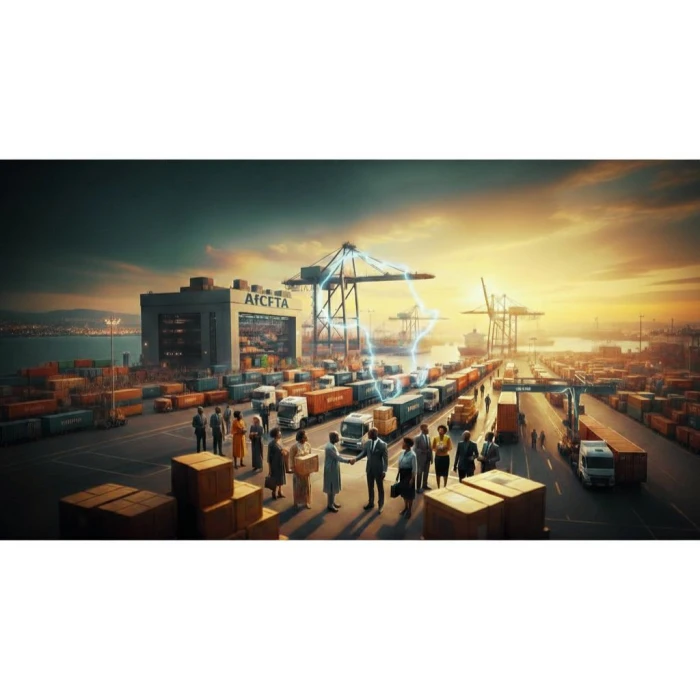
Huge and fragmented has been how the map of Africa has been viewed by the global logistics and trade industry for decades. One can only imagine the complexity of navigating 55 individual border controls, distinct regulatory regimes and different tariff structures. Africa, for importers and exporters, was no more than a place of resource extraction. It was rarely looked at as a consumer market. That idea of Africa, however, is now obsolete.
The African Continental Free Trade Area (AfCFTA) has made Africa the world’s largest free trade area since the World Trade Organization was created some 30 years ago. And it’s going to connect around 1.3 billion people, whose combined GDP is nearly $3.4 trillion. This agreement has propelled a positive transition of the continent. From a ‘just-in-case’ continent where supply chains were unpredictable, Africa is now being seen as a ‘just-in-time’ continent where goods arrive exactly when they are needed.
The AfCFTA is reshaping the perception of Africa for importers, exporters and logistics providers globally. Here’s how the continent is achieving this.
The neighbours are welcoming each other.
Single nodes are no longer seen as reliable since the vulnerabilities were exposed during the recent pandemic and the geopolitical tensions that have followed. Traders have realised that diversification is key and new manufacturing hubs and raw material sources are required for stability.
The AfCFTA is not simply about reducing tariffs; it is about making the rules of origin consistent throughout. Before the agreement, prohibitive duties would be applicable on Nigerian manufactured goods trying to enter Kenya. Now, the goods produced anywhere within the African continent move freely. This has allowed the continent to be seen as a viable manufacturing base rather than a mere raw material exporter.
The streamlined regulations mean that the ‘friction cost’ of doing business has lowered, nudging Africa to move up the global value chain. It is now moving beyond copper and cobalt to become a source of intermediate products and finished goods.
The consumers are demanding more.
The next consumer boom is growing in the AfCFTA, and global exporters are lining up for a front-row seat in this market. It's impossible to ignore the demographic shift as well, since by the year 2050, 1 in 4 people on Earth are going to be African. Which means that quality apparel, auto parts, consumer electronics and machinery will be in high demand by the young population, which is rapidly urbanising.
The barrier to entering the African market has been navigating the previously 54, now 55, different markets which the AfCFTA has dismantled. This means that a manufacturer in Europe or Asia no longer has to negotiate trade agreements with 55 separate governments for market access.
Africa is moving away from being treated as a dumping ground for low-quality inventory. It is a mature consumer market expecting high-quality input. And the agreement has made it easy for exporters to scale operations in the continent without the need to tackle multiple administrative mazes.
Watch the panel discussion with industry experts on CNBC Africa here.
The digital boom's advantage for logistics.
The aggressive push towards digital integration after the AfCFTA agreement is exciting for logistics service providers and traders. Just like how Africa has leapfrogged straight to mobile phones while skipping landlines, they are doing the same with payments and trade infrastructure. The implementation of electronic tracking systems, paperless customs and smart borders is a game changer. This has played a key role in solving the visibility problem, one of the biggest risks in cross-border logistics, once goods enter a border checkpoint. No more worries at port and land border posts, as digital customs declarations and automated inspections have made logistics easy. Payments have been streamlined with the introduction of the Pan-African Payment and Settlement System.
The continent continues to invite logistics and shipping companies to bring their expertise and help build the backbone of this new free trade economy. There is a big opportunity to build the architecture of the entire supply chain required by 1.3 billion people.
Calling new partners.
Through the AfCFTA, the continent has announced to the world that Africa is open for business. They are looking for partners and not charity. The big puzzle of Africa is now a single photograph, which traders and logistics service providers can no longer overlook. With the red tape being removed, the possibilities are as vast as the continent.