
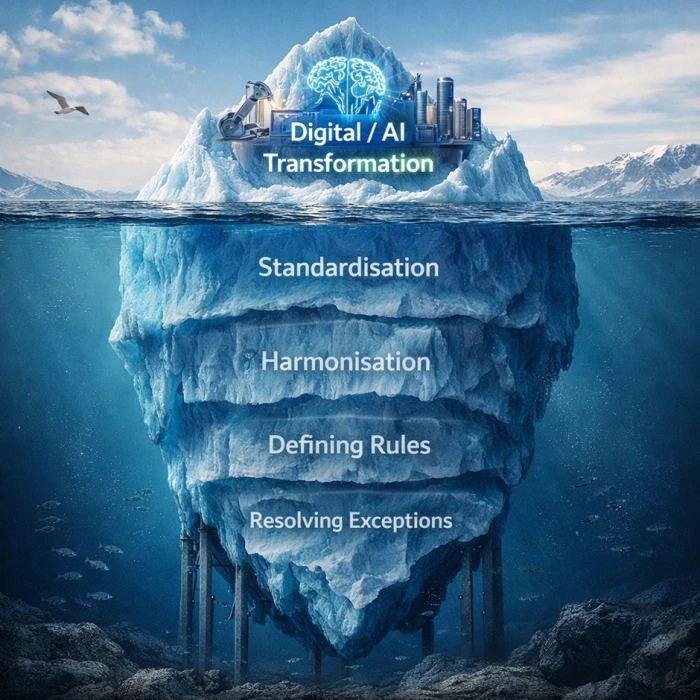
Why Process Excellence Matters Even More in the Age of AI
Over the past year, almost every organisation I meet wants to become “AI-first.”
There is excitement everywhere.
New tools. New pilots. New transformation decks.
The expectation is simple: AI will make the organisation faster, smarter, and more efficient.
But there is one uncomfortable reality that rarely gets discussed.
AI does not fix broken processes.
It amplifies them.
The Old Problem in a New Form
Most organisations don’t suffer from a lack of technology.
They suffer from process inconsistency.
The same activity is performed five different ways across teams.
Approvals travel through email chains.
Critical data sits in spreadsheets owned by individuals.
Rules exist, but mostly in people’s heads.
When AI enters this environment, it doesn’t magically clean things up.
Instead, it starts learning from the same messy inputs.
If the process is inconsistent, the outputs become inconsistent too.
Suddenly the organisation has automated confusion.
Technology Is the Castle. Process Is the Foundation.
Think of transformation like building a castle.
Everyone sees the towers, the walls, the impressive architecture.
But what actually determines whether the castle stands or collapses is the foundation underneath.
Process discipline is that foundation.
Standardised workflows.
Clear ownership.
Defined decision rules.
Reliable data.
Without these, even the most sophisticated technology sits on unstable ground.
Why the Process Layer Gets Ignored
The work of process excellence is not glamorous.
It involves mapping workflows.
Removing unnecessary steps.
Standardising practices across teams.
Cleaning data and defining rules.
This work rarely produces exciting announcements.
There is no “launch day.”
But it quietly determines whether transformation will succeed.
What Successful AI Transformations Do Differently
In organisations where AI actually delivers value, a pattern usually appears.
Before deploying advanced technology, they invest time in fixing the basics.
They ask questions like:
● Do we have a single version of the process across teams?
● Are the inputs consistent and reliable?
● Are decision rules clearly defined and documented?
● Can the workflow run predictably without human improvisation?
Once these answers become clear, AI becomes extremely powerful.
Because now it sits on top of something stable.
The Real Order of Transformation
In practice, the sequence that works looks like this:
- Standardise the process.
- Clean the data.
- Clarify decision rules.
- Then apply automation or AI.
Many organisations reverse this order.
They start with technology and hope the process will fix itself later.
It rarely does.
The Role of Leadership
For leaders, the temptation is understandable.
Technology announcements create momentum.
Process work feels slow and invisible.
But sustainable transformation requires patience.
The organisations that win in the long run are rarely the ones with the flashiest tools.
They are the ones with the clearest systems.
A Simple Way to Think About It
AI can make your organisation faster.
But it cannot decide what should happen in the first place.
That clarity still comes from good process design.
In other words, technology can build impressive castles.
But only strong foundations keep them standing.