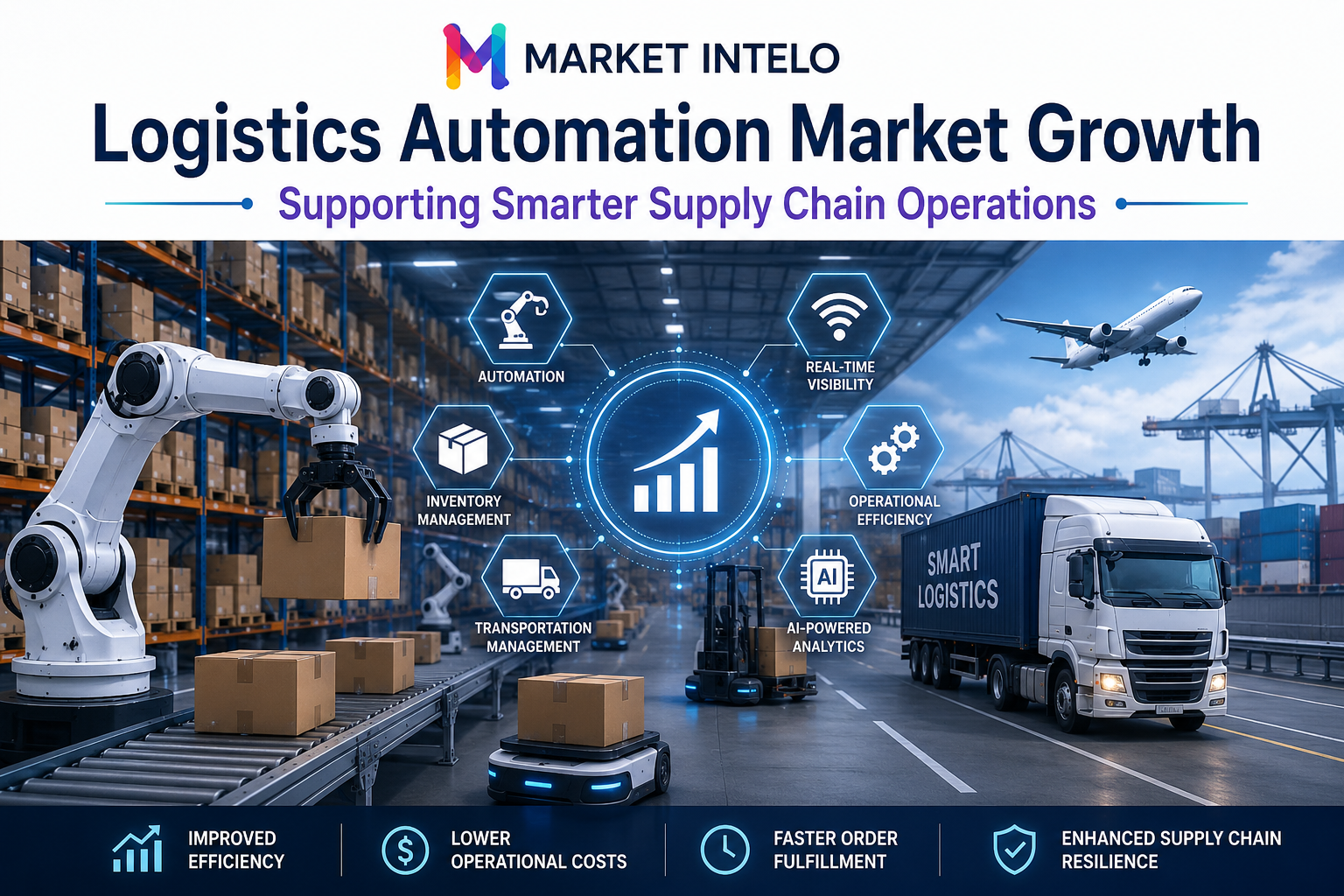
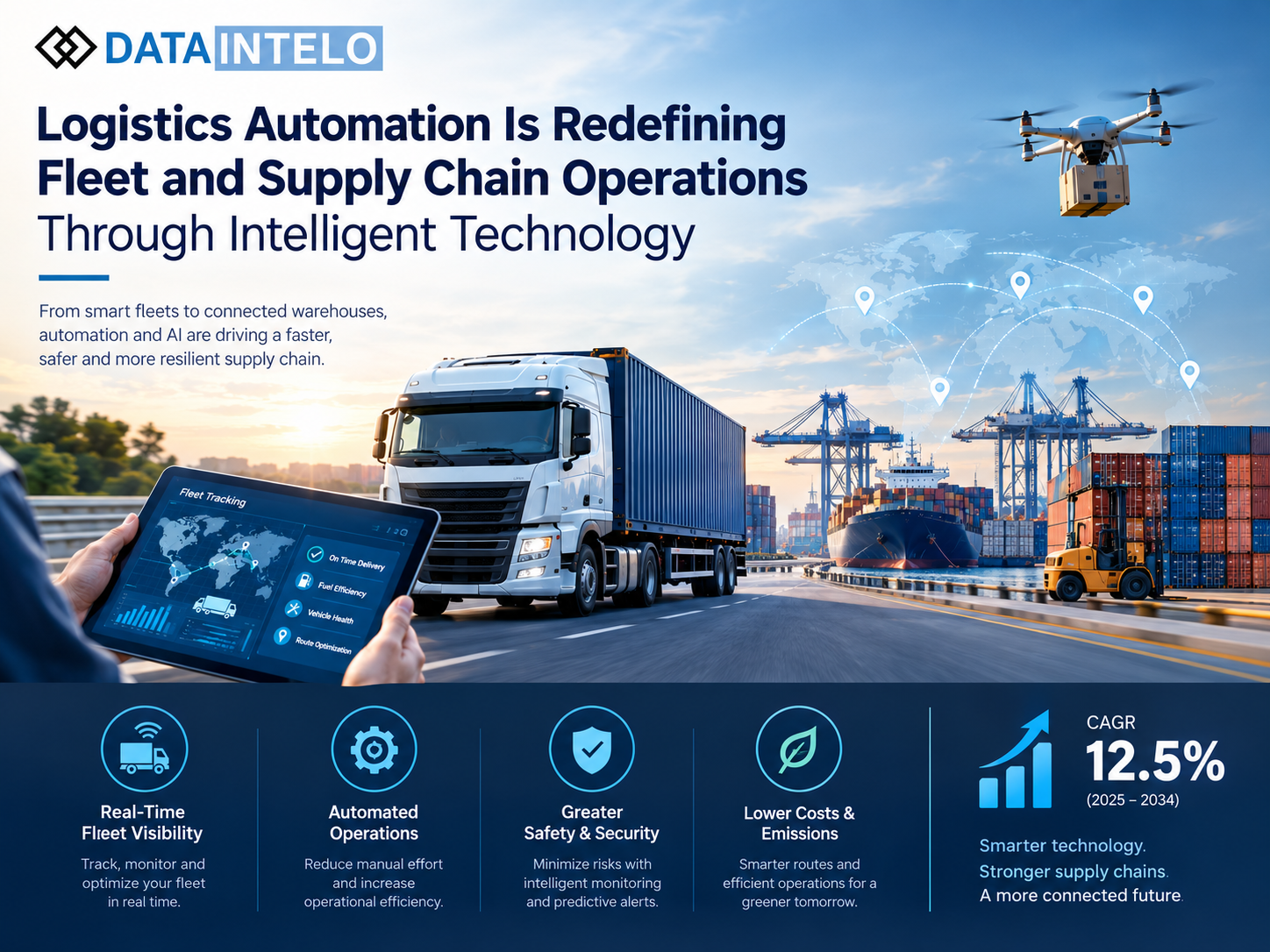
Logistics automation is changing how freight moves from manufacturers and warehouses to customers. The transformation is no longer limited to automated conveyors, robotic arms, or barcode scanners. Modern logistics networks increasingly combine artificial intelligence, Internet of Things sensors, telematics, cloud platforms, warehouse management systems, transportation management systems, robotics, digital documentation, and real-time analytics.
The financial scale of this transformation is substantial. The global logistics automation market reached $75.8 billion in 2025 and is projected to expand to $219.8 billion by 2034, representing a compound annual growth rate (CAGR) of 12.5% as per DataIntelo’s analysis. This expansion reflects increasing investment in automated material handling, warehouse systems, intelligent transportation technologies, robotics, software platforms, and data-driven logistics management.
The result is a shift from periodic decision-making toward continuously measured operations. Vehicle locations, shipment status, warehouse activity, inventory movements, travel times, and infrastructure conditions can increasingly be converted into digital information. This allows logistics managers to identify bottlenecks, forecast disruptions, coordinate resources, and measure performance using operational data rather than assumptions.
Data Is Becoming the Operating Layer of Logistics
Traditional logistics management depended heavily on scheduled dispatches, manual documentation, telephone coordination, spreadsheets, and periodic vehicle inspections. Automation replaces many of these disconnected activities with continuous data flows.
Telematics devices can transmit vehicle location, speed, fuel behavior, engine parameters, braking events, and diagnostic information. IoT sensors can monitor temperature, humidity, vibration, door openings, and cargo conditions. Warehouse systems can record inventory movements at individual stock-keeping-unit level.
The U.S. Bureau of Transportation Statistics provides a useful example of how freight data is being captured at national scale. Its Freight Mobility Initiative uses aggregated and anonymized GPS-position information from approximately 350,000 unique truck tractors operating across North America. The database covers vehicle movements dating back to October 2018 and supports analysis of travel patterns between thousands of geographic locations.
This type of dataset changes fleet management from simple location visibility to network intelligence. Instead of asking where a truck is, operators can examine travel times, recurring delays, route performance, and geographic bottlenecks.
Fleet Automation Targets Utilization and Predictive Maintenance
Fleet automation creates opportunities to improve vehicle utilization. Route-planning software can combine delivery addresses, vehicle capacity, traffic conditions, time windows, road restrictions, and shipment priorities. Algorithms can then evaluate different sequences and recommend routes that satisfy operational constraints.
Predictive maintenance adds another layer. Instead of servicing every vehicle according to a fixed calendar, maintenance systems can use engine diagnostics, fault codes, mileage, operating conditions, and historical failure patterns to identify vehicles requiring attention.
The economic logic is straightforward. A vehicle breakdown can affect driver schedules, customer delivery commitments, replacement-vehicle requirements, and downstream warehouse planning simultaneously. Detecting abnormal operating conditions earlier can therefore protect multiple parts of the logistics process.
The U.S. government's freight-mobility program demonstrates why transportation data has strategic importance. Rather than relying only on surveys or periodic reports, transportation authorities can increasingly use continuously generated location data to understand how freight actually moves.
Warehouse Automation Is Moving Toward Orchestration
Warehouses are becoming integrated execution environments rather than passive storage locations. Automated storage and retrieval systems, autonomous mobile robots, automated guided vehicles, robotic picking, machine vision, sortation equipment, conveyors, scanners, and warehouse software can work together to coordinate physical inventory movement.
However, automation performance depends heavily on software integration. A robot can move a product rapidly, but if inventory records are inaccurate, the system can still generate an incorrect fulfillment decision. Similarly, automated picking can increase throughput while creating downstream congestion if packing capacity is not synchronized.
This makes warehouse automation a coordination problem as much as a robotics problem. Inventory databases, order-management systems, warehouse-control systems, transportation platforms, and workforce scheduling tools need to exchange accurate information.
The objective is therefore not simply to install more machines. It is to create an environment in which physical equipment and digital systems operate according to the same operational picture.
Artificial Intelligence Connects Planning With Execution
Artificial intelligence becomes particularly valuable when it operates across multiple logistics datasets. Demand forecasts can influence inventory positioning. Inventory availability can affect order allocation. Order information can determine vehicle requirements. Transportation conditions can change delivery sequences. Actual delivery performance can then feed information back into future planning.
This creates a continuous operational loop:
Sense → Predict → Decide → Execute → Measure → Improve
For example, an AI system can identify recurring delays on a particular route. A transportation platform can evaluate alternative routes or dispatch times. If the delay is caused by warehouse congestion rather than road conditions, the system can instead modify loading schedules.
The value comes from connecting datasets rather than simply adding another software application. A warehouse platform that cannot communicate with transportation software may improve one process while leaving the wider network unchanged.
Data integration is therefore becoming one of the most important foundations of logistics automation.
India Is Building Logistics Connectivity at Scale
India provides a strong example of logistics digitization at national scale. According to the World Bank, India's position in the Logistics Performance Index improved from 54th in 2014 to 38th in 2023. The Indian government has set an objective of reaching the top 25 by 2030.
Digital infrastructure is central to this strategy. The Unified Logistics Interface Platform, or ULIP, was developed to connect logistics-related government systems through APIs.
According to the Ministry of Commerce and Industry, ULIP had connected 43 systems across 11 ministries through 129 APIs, covering more than 1,800 data fields, by March 2025. The platform had more than 1,300 registered companies and had processed more than 100 crore API transactions.
By August 2025, government information reported that ULIP had facilitated more than 160 crore digital transactions across more than 30 digital systems. This demonstrates how logistics digitization is moving beyond individual companies toward shared infrastructure for information exchange.
Logistics Data Bank Demonstrates the Value of Visibility
The Logistics Data Bank provides another example of technology-enabled freight visibility in India.
The platform tracks EXIM containers and provides stakeholders with information about cargo movement across the logistics chain. Government data reported that LDB had tracked more than 75 million EXIM containers by October 2024, with more than 45 lakh unique container searches per month.
The system has since reached an even larger milestone. Government information reported that the Logistics Data Bank had tracked 10 crore EXIM containers since its launch in 2016.
This progression illustrates an important principle of logistics automation: visibility becomes more valuable as more transactions and transport movements enter a common digital environment.
LDB 2.0 Is Extending Real-Time Visibility
India's digital logistics infrastructure is also moving toward more detailed shipment intelligence. The government launched Logistics Data Bank 2.0 in September 2025, with the objective of improving logistics efficiency, supporting MSMEs, and strengthening supply-chain visibility.
LDB 2.0 connects with ULIP APIs and provides real-time visibility across road, rail, sea, and high-sea movements. Its capabilities include container heatmaps and tracking using container numbers, vehicle numbers, and railway Freight Name Record numbers.
Such systems illustrate how logistics automation is evolving from basic tracking toward decision support. Knowing that a shipment is delayed is useful; identifying where the delay is occurring and giving operators information to respond is considerably more valuable.
Multimodal Infrastructure Needs Digital Intelligence
Automation becomes more valuable when roads, railways, ports, warehouses, inland logistics facilities, and other infrastructure can exchange information.
India's PM GatiShakti National Master Plan is designed around integrated infrastructure planning using geospatial information. The initiative brings together infrastructure information from multiple ministries and departments to support coordinated planning.
The government has also expanded public access to geospatial and infrastructure information through the PM GatiShakti Public platform and Unified Geospatial Interface. These initiatives are intended to improve access to infrastructure data and support more coordinated planning and decision-making.
The significance for logistics is considerable. When infrastructure information, shipment data, vehicle positions, and facility capacity can be evaluated together, planners can identify connectivity gaps and potential bottlenecks before they become major operational constraints.
Automation Must Be Measured Through KPIs
A technology investment should be evaluated through operational metrics rather than the number of machines installed.
| Automation Area | Key KPI | Operational Objective |
| Fleet telematics | Vehicle utilization | Increase productive asset hours |
| Route optimization | Empty kilometer's | Reduce unnecessary movement |
| Predictive maintenance | Unplanned downtime | Improve fleet availability |
| Warehouse robotics | Units per hour | Increase throughput |
| Inventory automation | Inventory accuracy | Reduce stock discrepancies |
| Digital documentation | Processing time | Accelerate shipment execution |
| AI forecasting | Forecast accuracy | Improve inventory planning |
The most useful KPI depends on the logistics model. A parcel network may prioritize delivery-cycle time and first-attempt success. A manufacturing supply chain may focus on line-side availability and inventory turnover. A cold-chain operator may prioritize temperature excursions and shipment compliance.
The important principle is to establish a measurable baseline before automation and compare the results after deployment.
Cybersecurity and Data Quality Become Critical
More connected systems also create greater technological dependency. A logistics network can contain thousands of sensors, vehicle devices, warehouse controllers, APIs, cloud applications, and employee interfaces. Each connection creates potential data-quality and cybersecurity risks.
Incorrect master data can cause wrong inventory decisions. Delayed sensor information can undermine real-time routing. Poor API integration can produce inconsistent shipment statuses. Cybersecurity failures can interrupt warehouse operations or expose commercially sensitive information.
Consequently, automation projects need governance alongside technology. Organizations should define data ownership, API standards, access controls, cybersecurity procedures, backup systems, and measurable service-level requirements before expanding automation across the network.
Data quality is particularly important because artificial intelligence cannot compensate for unreliable operational inputs. A sophisticated model working with incomplete inventory records or inaccurate vehicle information can produce decisions that appear intelligent but are operationally incorrect.
The Future Is Autonomous but Still Data-Driven
The next generation of logistics will not be defined by one technology. AI needs accurate data. Robotics needs reliable instructions. Fleet automation needs telematics. Warehouse automation needs inventory synchronization. Transportation optimization needs accurate orders, capacity information, and operating constraints.
The strongest logistics networks will therefore combine these technologies into a connected decision architecture.
India's progress demonstrates the direction. ULIP has moved from an integration initiative to a large-scale digital logistics platform, while the Logistics Data Bank has now tracked 10 crore EXIM containers.
These figures indicate that logistics is becoming increasingly measurable at network scale. The competitive advantage will come not simply from replacing manual work with machines, but from transforming operational data into faster and more accurate decisions.
Logistics automation is ultimately the convergence of physical execution and digital intelligence. Fleets, warehouses, inventory systems, transportation platforms, and infrastructure networks are moving toward continuous sensing, prediction, execution, and feedback.
Companies that establish strong data foundations, integrate systems, measure performance rigorously, and automate processes progressively will be better positioned to build faster, more resilient, and more intelligent supply chains.
Reference: https://dataintelo.com/report/global-logistics-automation-market