
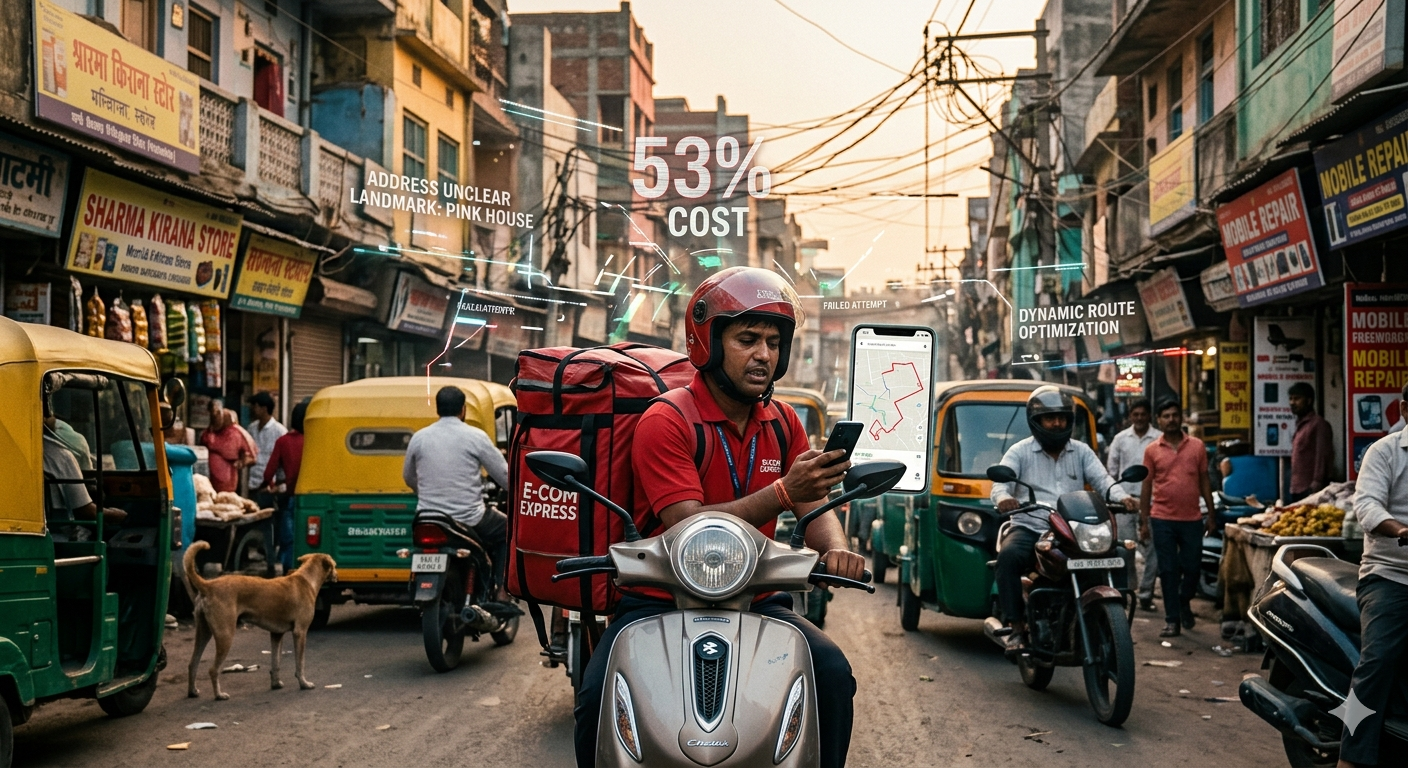
India's logistics industry has grown at a remarkable pace over the last decade. Warehouses have modernised, freight corridors have expanded, and e-commerce has pushed delivery expectations to new heights. Yet for all this progress, one stubborn problem remains largely unsolved: the last mile.
The last mile is the final leg of a delivery journey from a distribution hub to the customer's doorstep. It sounds deceptively simple. In reality, it accounts for nearly 53% of total shipping costs and remains the most operationally complex part of the entire supply chain. In India, this complexity is amplified by dense urban lanes, inconsistent addressing systems, unreliable rural connectivity, and a delivery workforce that is largely informal and under equipped.
The Scale of the Problem
India processes hundreds of millions of e-commerce shipments annually, and that number is growing. Behind each successful delivery is a chain of micro-decisions including route selection, address verification, customer availability, and vehicle load optimisation. Most of these decisions are still made manually or through fragmented tools. Failed delivery attempts, customer rescheduling, and address mismatches cost logistics companies significant time and money every day.
In Tier 2 and Tier 3 cities, the challenge deepens. Addresses often lack pin-code precision. Landmarks replace street names. A delivery agent navigating an unfamiliar colony has little more than a phone number and a rough locality name to work with. The result is delays, failed attempts, and frustrated customers on both ends.
Where Technology Has Fallen Short
Several logistics platforms have tried to digitise last-mile delivery, but most solutions are built for scale rather than ground-level usability. Enterprise route optimisation tools work well for large fleets but are inaccessible to small logistics operators and independent delivery partners. Real-time tracking exists, but the underlying data including accurate geolocation, traffic patterns, and delivery success rates by area is rarely surfaced back to the people who need it most.
There is also a gap in the feedback loop. When a delivery fails, the reason is often logged as a generic status update. The nuance of whether the customer was unavailable, the address was wrong, or the lane was inaccessible to vehicles gets lost entirely. Without this granular data, the same mistakes repeat.
A Builder's Perspective on Last Mile
Last Mile as a product concept starts from a different premise. Instead of building another enterprise dashboard, what if you built a tool that actually works for the delivery agent on the ground and the small logistics operator running ten vehicles?
The focus shifts to three core problems. The first is address resolution, using geocoding and local landmark mapping to convert informal Indian addresses into navigable coordinates. The second is dynamic route suggestions, lightweight routing that accounts for real traffic, delivery time windows, and vehicle type without requiring expensive integrations. The third is failure intelligence, capturing structured reasons for delivery failures and surfacing patterns back to operators so they can improve first-attempt success rates over time.
This is not about replacing human judgment. It is about giving delivery agents and small operators the same quality of decision support that large logistics companies have always had access to, without the enterprise price tag or the complexity.
Why This Matters Now
Quick commerce has completely reset customer expectations. Two-hour and ten-minute delivery windows, once a novelty, are now a baseline expectation in metro cities. This pressure is trickling down to every layer of the logistics chain. Small and mid-size logistics operators who handle a significant share of India's actual deliveries are being asked to meet these expectations with outdated tools and thin margins.
Solving last-mile delivery in India is not just a logistics problem. It is an infrastructure problem, a data problem, and a design problem all at once. The solutions that will work here need to be lightweight, vernacular-friendly, and built for connectivity constraints. They need to earn the trust of delivery agents, not just the operators paying for the software.
Looking Ahead
The next wave of last-mile innovation in India will not come from large platform companies alone. It will come from focused tools that solve one part of the problem well, whether that is address accuracy, failure tracking, agent communication, or load optimisation, and integrate cleanly with the systems already in use.
As AI and real-time data become more accessible, even small logistics operators will be able to make smarter routing decisions, predict delivery failures before they happen, and build the kind of operational consistency that turns first-time customers into repeat ones.
India's last mile is hard. But it is also where the real opportunity lies, for builders, operators, and the millions of customers waiting on the other side of that final kilometre.