
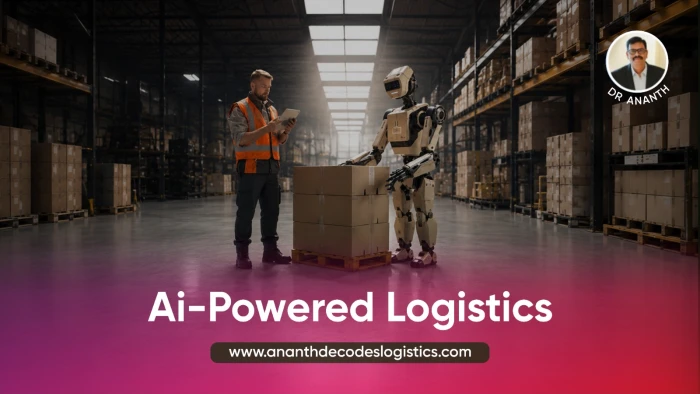
A considerable transformation is underway in India’s warehouses. The central argument is simple: policy, data, and automation are now jointly shaping logistics, with supervisors and AI-based robotic systems complementing one another’s strengths in real time.
Robots are not replacing supervisors, nor are supervisors simply overseeing robots. Instead, they form a new operating model in which human assessment and artificial intelligence combine to deliver speed, precision, resilience, and compliance.
This model has moved beyond pilot projects and is quickly becoming the strategic blueprint for India’s logistics sector.
This transformation isn't driven by technology alone, but accelerated by deliberate public policy. In recent years, the Government of India has developed one of the world’s most comprehensive digital logistics ecosystems, creating the regulatory and technological foundation for extensible AI-driven supply chains.
As a result, the warehouse has grown beyond a storage facility and now serves as the point where national policy meets operational implementation.
A Cabinet Decision That Changed the Direction of Indian Logistics
The turning point happened on 17 September 2022, when the Union Cabinet approved the National Logistics Policy (NLP).
Although the announcement received limited attention outside the logistics sector, its long-term impact is still significant. For the first time, India formally recognized logistics as a unified economic system rather than a set of disconnected activities such as transportation, warehousing, customs, ports, railways, and taxation.
The policy set a clear national objective: reduce India’s logistics costs, currently about 13–14% of GDP, to globally competitive levels while improving supply chain efficiency throughout all industries.
The results are already becoming visible.
India advanced from 44th in 2018 to 38th in the World Bank’s Logistics Performance Index in 2023. The logistics sector is also forecasted to maintain strong double-digit growth in the coming years.
However, rankings tell only part of the story; the bigger change lies in the digital architecture now taking shape.
The National Logistics Policy’s key achievement is a digital architecture that enables intelligence, not just movement, across the logistics system.
ULIP: Building India’s Digital Nervous System
Every intelligent warehouse relies on one essential element before robotics, automation, or AI can deliver value.
Data.
Historically, India’s logistics data existed in silos.
Vehicle information sat in one government database.
The driver records in another.
GST compliance elsewhere.
FASTag transactions followed their own ecosystem.
Ports, railways, customs authorities, freight operators, and warehouses all maintained separate systems with limited interoperability.
Artificial Intelligence cannot optimise fragmented information.
To address this, the Government launched the Unified Logistics Interface Platform (ULIP), a national digital gateway that integrates logistics data across ministries, departments, and private stakeholders.
ULIP connects systems, including:
- Vahan and Sarathi
- GSTN
- e-Way Bills
- FASTag
- Port Community Systems
- Railway logistics platforms
- Airport cargo systems
Standardised APIs now enable these previously disconnected ecosystems to communicate with one another.
By early 2025, ULIP had surpassed 100 crore API transactions, connecting logistics systems across ministries and allowing real-time visibility formerly unattainable.
This development changes operations for manufacturers, logistics providers, and warehouse operators, making the earlier data integration immediately relevant.
Inventory can now be synchronised with transportation.
Delivery schedules can adjust automatically to traffic conditions.
Likely disruptions are able to now be identified as exceptions before they worsen.
The warehouse is no longer an isolated facility. It now functions as an intelligent node within a connected national logistics network.y.
It now functions as an intelligent node within a connected national logistics network.
PM Gati Shakti: Intelligence Needs Infrastructure
Digital visibility alone cannot eliminate logistics inefficiencies, so physical infrastructure must progress alongside it.
Physical infrastructure must progress alongside digital infrastructure.
At this stage, the PM Gati Shakti National Master Plan becomes essential.
Roads.
Railways.
Ports.
Airports.
Industrial corridors.
Freight terminals.
Warehousing clusters.
Rather than developing independently, these assets are now planned through an integrated geospatial platform, enabling ministries to coordinate infrastructure investments.
If ULIP serves as India’s digital nervous system, PM Gati Shakti provides its physical skeleton, completing the same national system.
Together, these projects create a system greater than the sum of their parts:
A logistics network where physical movement and digital intelligence reinforce one another.
This linkage matters because AI systems generate meaningful operational value only when digital intelligence and physical infrastructure work together.
Why AI Is Finally Becoming Commercially Viable
For decades, Indian warehousing was predominantly labour-intensive.
That model made economic sense.
Labour was relatively inexpensive.
Capital investment was difficult to justify.
Operational variability was considered standard.
Today’s market operates under entirely different conditions.
E-commerce promises next-day delivery.
Quick commerce measures fulfilment in minutes.
Manufacturing increasingly follows just-in-time production.
Global customers expect end-to-end shipment visibility.
These expectations significantly reduce tolerance for manual inefficiencies.
As a result, AI has shifted from experimental use to operational necessity.
Across modern warehouses, organisations are increasingly deploying:
- Predictive demand forecasting
- AI-driven inventory optimization
- Computer vision for quality inspection
- Intelligent warehouse management systems
- Autonomous guided vehicles (AGVs)
- Robotic palletising systems
- AI-assisted sortation
- Humanoid robots for repetitive material handling tasks
Importantly, these technologies are not replacing people; instead, they are removing repetitive tasks.
These technologies eliminate repetitive tasks, enabling employees to focus on judgment, exception management, customer service, safety, and operational decision-making, while improving overall workflow performance.
Competitive advantage now favours companies with the most intelligent warehouses, rather than those with the largest facilities.
AI Without Trust Cannot Scale
Technology talks often celebrate speed.
Executives, however, must think equally about governance.
Every AI-enabled logistics operation processes enormous volumes of personal and commercial data.
Driver locations.
Vehicle telemetry.
Customer addresses.
Employee productivity.
Supplier information.
Delivery choices.
Behavioural analytics.
Without clear governance, AI can become a compliance risk instead of a competitive advantage.
India’s Digital Personal Data Protection Act, 2023 (DPDP Act), fundamentally changes this conversation.
Although India has not enacted dedicated AI legislation, the DPDP framework sets up legally enforceable obligations for every organisation that processes personal data.
The subsequent Digital Personal Data Protection Rules, 2025, alongside the establishment of the Data Protection Board of India, provide the operational systems for implementation.
For logistics leaders, AI governance now goes beyond technology selection.
Boards must evaluate:
- Consent management architecture
- Data minimisation practices
- Security controls
- Breach response mechanisms
- Vendor accountability
- Cross-border data transfers
- AI transparency and auditability
Compliance is no longer solely a legal department concern; it has become an enterprise risk management issue that affects the whole operation.
It has become an enterprise risk management issue.
Organisations that implement AI responsibly today will achieve substantially greater business agility in the future.
The Leadership Question
The greatest misconception surrounding AI is that it is fundamentally a technology initiative. It is not. It is a leadership initiative.
Successful AI adoption requires executives to redesign workflows, reconsider organisational structures, reskill employees, strengthen governance, and encourage cultures that trust data while continuing human decision making. Technology can automate decisions. Leadership determines which decisions should remain human. The warehouse of the future will not be defined by the number of robots it contains. It will be defined by the effectiveness of collaboration with humans, machines, and data.
India’s Logistics Moment
India stands at a rare convergence of policy, infrastructure, digital public platforms, manufacturing growth, and technological capability.
The National Logistics Policy established the strategic vision.
PM Gati Shakti integrated physical infrastructure.
ULIP connected fragmented information into a unified digital ecosystem.
The Digital Personal Data Protection framework introduced the governance necessary for responsible AI adoption.
Together, these projects are transforming logistics from a cost centre into a strategic national capability.
Indian enterprises now have the opportunity to move beyond digitising existing operations.
The imperative is to redesign these operations for the next stage of logistics.
Warehouses are evolving from storage places into centres for generating intelligence, carrying forward the shift already underway.
In the next decade, competitive advantage will not go to organisations that simply adopt Artificial Intelligence.
It will belong to those who combine technology with governance, automation with accountability, and invention with effective execution, as this piece has shown.
In India’s next logistics revolution, the most valuable asset will not be the robot lifting the pallet.
It will be the leadership that understands why the robot—and the policy framework permitting it—arrived there in the first place.