
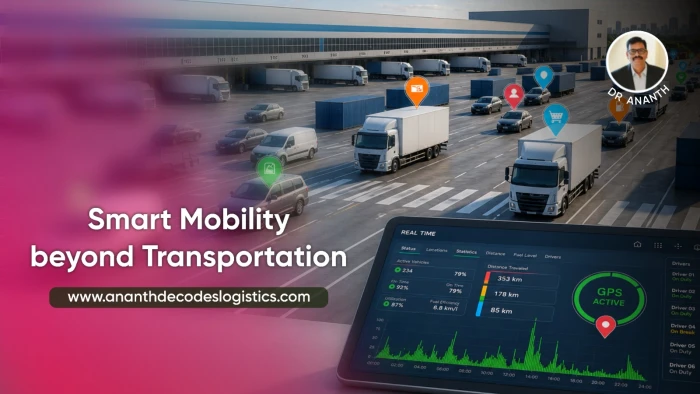
An Executive Perspective
For decades, India’s mobility agenda has centred on transportation, including road construction, bus deployment, and increased vehicle ownership. That approach has now fundamentally changed.
Smart mobility now goes beyond transportation, serving as a strategic pillar for national development. It influences urban planning, industrial competitiveness, energy security, digital infrastructure, climate resilience, and citizen well-being. Business leaders, policymakers, investors, and urban planners must recognise this shift to take informed decisions in the coming decade.
From Transport Infrastructure to Mobility Ecosystems
The Union Budget 2026-27 clearly reflects this transition. Rather than prioritising infrastructure expansion or electric vehicle adoption alone, it signals a deliberate move toward developing mobility ecosystems.
The emphasis has moved beyond vehicles. The focus has shifted from deploying vehicles to strengthening domestic manufacturing, securing supply chains, developing battery technologies, and building integrated mobility systems. Ongoing customs duty exemptions for capital goods used in lithium-ion cell manufacturing show that electric mobility closely aligns with India’s broader goals for energy security, critical minerals, and advanced manufacturing. Mobility is no longer treated as an independent transport sector. It is increasingly positioned as an enabler of industrial competitiveness under the Atmanirbhar Bharat and Viksit Bharat 2047 vision.
India’s regulatory framework is developing alongside this policy shift.
For example, the Department of Telecommunications has exempted Cellular Vehicle-to-Everything (C-V2X) communication devices operating in the 5875-5905 MHz spectrum from licensing requirements. This regulatory reform removes a major barrier to the nationwide deployment of connected vehicle technologies.
The implications reach beyond vehicle communication. C-V2X enables instantaneous interaction among vehicles, traffic infrastructure, emergency services, pedestrians, and intelligent transport systems, establishing a digital foundation for safer roads, predictive traffic management, autonomous mobility, and smart city ecosystems.
For automotive manufacturers, telecom providers, infrastructure developers, and technology companies, this regulatory clarity reduces investment uncertainty and positions India to adopt emerging global mobility technologies at scale. A defining characteristic of India’s current mobility transformation is its shift from vehicle-centric planning to integrated urban mobility, linking transport planning with land use, public health, environmental protection, accessibility, and citizen safety.
Tamil Nadu’s Urban Mobility Priorities 2031 illustrates this systems approach. Using mobility data from about 55,000 households across twelve municipalities, the framework intends to markedly increase the share of public transport and active mobility by 2048.
Similarly, Chennai’s first Pedestrian Priority Street, supported by a program to develop nearly 170 kilometres of pedestrian infrastructure as part of an area-level parking management strategy, sends an important policy message: smart mobility is evaluated not only by digital innovation but also by the quality, safety, and inclusiveness of public spaces.
This denotes a transition from vehicle-first planning to people-first mobility.
Public Transport Electrification and Climate Finance
Electrification continues to reshape India’s public transport sector.
More than 13,500 electric buses are already operational nationwide, with over 20,000 additional buses under procurement. This growth is boosting urban air quality while cutting long-term operating costs for transport authorities.
Equally significant is the emergence of carbon finance within mobility governance. Urban Local Bodies and State Transport Undertakings are increasingly being encouraged to monetise emissions reductions through carbon credit mechanisms.
This turns public transport electrification from a purely environmental initiative into a financially sustainable investment model, creating new revenue streams while supporting India’s climate commitments.
Digital Integration Through Mobility-as-a-Service
Physical infrastructure alone cannot deliver uninterrupted mobility.
Mobility-as-a-Service (MaaS) has appeared as a digital layer that integrates metro systems, buses, ride-hailing services, auto-rickshaws, bicycles, and last-mile mobility into a unified user experience.
Cities such as Bengaluru and Delhi are expanding integrated mobility platforms that simplify journey planning, digital payments, and multimodal connectivity. The goal goes beyond technological convenience; these platforms seek to reduce dependence on private vehicles, improve public transport utilisation, and reshape commuter behaviour through integrated mobility. In this context, integration is increasingly becoming as important as physical infrastructure.
Navigating India’s Shifting Regulatory Setting
While innovation continues to accelerate, regulatory complexity remains a defining feature of India’s mobility sector.
Ride-hailing, bike taxis, shared mobility, and micro-mobility continue to expand rapidly. However, regulatory approaches differ considerably across states. The recent Karnataka High Court order temporarily suspending bike-taxi operations illustrates how state-level decisions can quickly reshape business models and operating strategies.
For organisations managing multi-state fleets, compliance cannot be handled through a single national framework.
Success increasingly depends on sustaining continuous visibility into state government policies, regulatory notifications, incentive programmes, licensing frameworks, and management guidelines.
In India’s mobility ecosystem, regulatory agility has become a competitive advantage.
Strategic Priorities for Business Leaders
Three strategic priorities emerge from India’s evolving mobility landscape.
First, mobility investments must be evaluated through an ecosystem perspective rather than a transportation perspective. Decisions involving battery manufacturing, semiconductor ecosystems, telecommunications infrastructure, renewable energy incorporation, and critical mineral supply chains are becoming essential to mobility strategy.
Second, government relations and regulatory intelligence must become core organisational capabilities. Divergent state policies on electric vehicles, shared mobility, urban transport, and digital infrastructure require region-specific strategies rather than uniform national approaches. Organisations that proactively monitor incentives, grants, compliance requirements, and emerging regulations will be better positioned for long-term growth.
Third, mobility must be recognised as an instrument of inclusive governance. Investments in pedestrian infrastructure, women-focused public transport, universal accessibility, safe routes to schools, and digitally connected transport systems indicate that the future of mobility is judged not only by efficiency, but also by safety, equity, accessibility, and quality of life.
Conclusion
India’s mobility transformation has decisively moved beyond traditional transportation, signalling a fundamental shift in how mobility is understood.
Mobility now serves as the connective framework linking industrial policy, urban development, digital infrastructure, energy security, climate action, and citizen welfare. The government policies, regulatory reforms, and state-level initiatives introduced throughout 2026 are not isolated administrative measures. Together, they represent a coordinated national strategy to build a connected, resilient, self-reliant, and integrated mobility ecosystem.
For leaders across government, industry, and investment communities, the strategic challenge is no longer simply expanding transport capacity. It coordinates capital allocation, innovation, regulatory compliance, and long-term business strategy with a policy environment that increasingly recognises mobility as core infrastructure for achieving the Viksit Bharat 2047 vision, and acts on that shift with immediacy.