Executive Summary
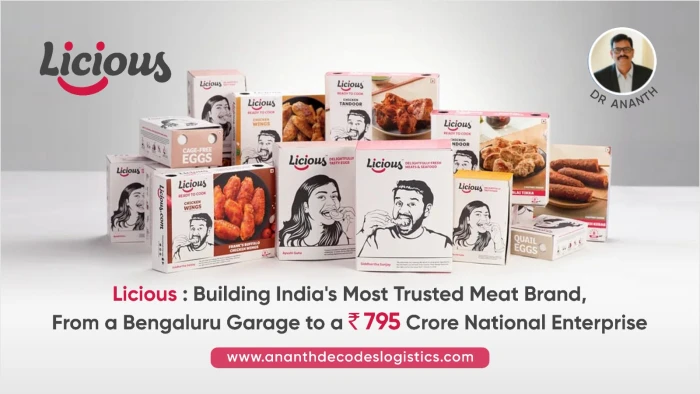
Founded in 2015 in Bengaluru, Licious has grown from a two-person startup to India’s largest D2C meat and seafood brand. Now a unicorn, it has raised over $490 million, serves 1.2 million monthly customers, and reported revenue of ₹795 crore in FY25. By building an end-to-end supply chain, Licious transformed a fragmented market into a national opportunity.
The Market Imperative
India’s meat and seafood market is valued at $40 billion annually. At the time of Licious’s founding, over 95% of the market was unorganised, with fragmented wet markets, unreliable supply chains, inadequate cold storage, and limited quality standards. Although over 73% of Indians consume non-vegetarian food, hygienic infrastructure remains lacking.
Recognising these challenges, Licious’s founders identified a transformative market opportunity beyond consumer inconvenience.
In 2015, Abhay Hanjura and Vivek Gupta launched Licious with the belief that fully controlled, exceptional quality could set new industry standards and create a sustainable business. Their goal was to deliver chef-grade, fresh, hygienic meat to Indian households. Gupta contributed financial discipline and capital expertise, while Hanjura focused on analytics and customer insight. Their strategy: direct oversight of sourcing, processing, storage, and delivery to ensure quality and accountability. This integrated model minimised intermediaries and built trust. In its first year, Licious generated ₹1.47 crore, showing consumers would pay a premium for reliable, hygienic, delivered meat. (ETBrandEquity, 2026)
Capital Formation: Funding a Category
After validating product-market fit in Bengaluru, Licious raised its first institutional round in 2016, led by Mayfield and 3one4 Capital. The funds were used to develop cold-chain infrastructure, packaging, and technology.
The company aligned fundraising with operational milestones. In 2017, it secured Series B funding of approximately ₹75 crore from Mayfield, 3one4 Capital, and Sistema Asia Fund.
- 2018: Series C & D – $25 million each from Bertelsmann India Investments, Vertex Ventures, and InnoVen Capital
- 2019: Series E – $30 million from Vertex Growth Fund, Nichirei Corp, and 3one4 Capital
- 2021: Series F – $192 million from Multiples Alternate Asset Management, Brunei Investment Agency, and Vertex Ventures
- 2021 (Unicorn Round): $52 million from IIFL Asset Management, lifting valuation past $1 billion and making Licious India’s first D2C unicorn
To date, Licious has raised $490 million across 12 rounds from 67 investors, including Temasek, Mayfield India, Vertex Ventures, and 3one4 Capital. (Singh, 2019)
Revenue Trajectory: Hypergrowth, Reset, and Recovery
Licious’s financials reflect discipline. In FY23–24, it closed third-party channels to focus on high-margin segments. Revenue declined by 9% (from ₹746 crore to ₹685 crore), but losses decreased by 44% to ₹293.77 crore. Quick commerce deliveries grew 35%, partially offsetting the revenue decline.
At the start of FY25, Licious achieved double-digit growth. Revenue increased 16% year-on-year to ₹795 crore, while EBITDA losses narrowed by 45% to ₹163 crore. In the first half of FY26, revenue rose 42% year-on-year to ₹530 crore. By December 2025, monthly revenue exceeded ₹100 crore.
Licious operates five processing facilities in Bengaluru, Hyderabad, Mumbai, and Gurugram, maintaining cold chain integrity and FSSC 22000 UKAS standards. Technology manages inventory and logistics, enabling the delivery of one million orders per month in 90 to 120 minutes.
A 90% repeat purchase rate and over 2 million unique customers last year demonstrate strong consumer trust. The Infinity loyalty program contributes 58% of revenue. Licious has expanded from Bengaluru to 28 cities, including Delhi NCR, Mumbai, Chennai, Hyderabad, and Kolkata. In each market, it localises supply chains using its "Orange Owl" approach, prioritising cold chain and processing before marketing. Product expansion has included ready-to-cook, heat-and-eat meals, cold cuts, spice blends, and eggs, serving both urban professionals and home cooks.
The Omnichannel Pivot: Offline as Strategic Evolution
Licious has recently entered offline retail. Its first Bengaluru outlet opened in April 2022, focusing on ready-to-cook products. In October 2024, it acquired 'My Chicken and More' for ₹150–200 crore, adding 26 stores to its portfolio. (Abrar, 2024)
This expansion represents a strategic shift in how Licious engages with consumers.
These initiatives demonstrate how adaptation has driven Licious's growth.
With its omnichannel expansion underway, Licious is now preparing for an IPO as early as 2026, marking a significant milestone in its growth and accountability.
For investors and strategists evaluating India’s consumer landscape, Licious stands out for identifying a genuine market gap, building proprietary infrastructure, and earning consumer trust at scale. Today, it translates that trust into sustainable financial returns and is well-positioned to lead India’s largest food category.