
Executive Summary
In global logistics, choosing between Full Container Load (FCL) and Less-than-Container Load (LCL) is a strategic decision. This choice directly affects cost efficiency, transit reliability, risk, and working capital.
Over the past five years, container shipping has shifted. COVID-19, the Russia–Ukraine conflict, Red Sea incidents, and protectionism are key factors. Rate swings, port congestion, and capacity imbalances now make FCL vs LCL decisions more dynamic and context-driven.
The following sections define FCL and LCL, highlight key differences and costs, and present a decision framework based on current research and practice. This sequence clarifies the analysis.
Understanding FCL and LCL
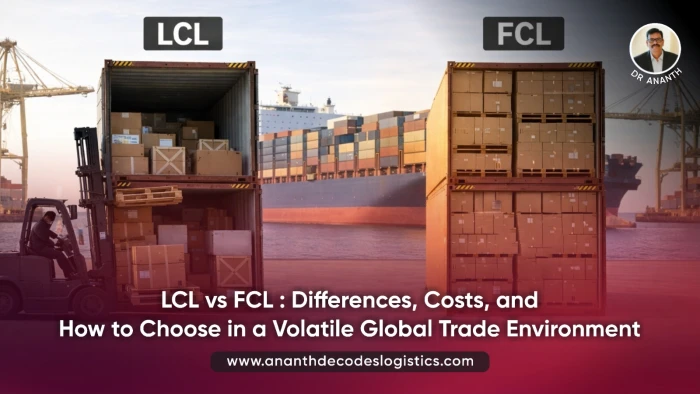
FCL is booking an entire container for one shipper, regardless of space used. LCL means multiple shippers share a container, and costs are based on cargo volume (CBM).
In essence:
- FCL = Capacity ownership
- LCL = Capacity sharing
This core difference causes variations in cost, speed, risk, and operational complexity.
Key Differences: Strategic Perspective
1. Cost Structure
FCL has fixed container prices covering ocean freight, terminal fees, and surcharges. LCL uses variable, per-CBM rates plus consolidation fees. LCL suits small volumes, but becomes uneconomical as volume rises.
- LCL suits smaller shipments but becomes less economical as size increases due to rising per-unit cost.
Industry benchmarks place the break-even point around 10–15 CBM: above this, FCL costs less; below it, LCL is usually more economical.
2. Transit Time and Reliability
FCL ships move directly from origin to destination with minimal handling. LCL requires consolidation at origin and deconsolidation at destination, adding 3–5 days or more.
With current port congestion and schedule unreliability:
- FCL offers higher predictability
- LCL introduces network dependency risks
3. Cargo Safety and Risk
FCL involves less handling and lowers the risk of damage or contamination. LCL's extra handling and co-loading expose shipments to more physical and compliance risks.
- Physical damage
- Misplacement
- Compliance risks (mixed cargo regulations)
Research shows that more handling increases the risk of damage.
4. Operational Complexity
LCL shipments require coordination with:
- Container Freight Stations (CFS)
- Consolidators
- Multiple documentation layers
FCL provides a single flow for greater control and visibility.
- LCL enables high-frequency, low-volume shipping
- FCL enables scale efficiency and cost optimisation
This trade-off is crucial for balancing demand volatility and inventory optimisation.
Cost Dynamics in the Last Five Years
From 2020 to 2025, ocean freight costs were highly volatile.
1. Pandemic-Induced Volatility
During COVID-19, freight rates rose 5–7 times due to container shortages and congestion.
- LCL became disproportionately expensive due to high per-CBM rates
- FCL was chosen for capacity assurance even when not full.
2. Geopolitical Disruptions
Recent disruptions, including:
- Red Sea shipping reroutes
- Russia–Ukraine war
- US–China trade tensions
These have increased transit times and fuel costs, and have created capacity imbalances.
This has led to increased both transit times and fuel costs.ad times
- Capacity imbalances across trade lanes
Under such conditions:
- FCL offers greater control over transit variability
- LCL becomes vulnerable to network disruptions and consolidation delays
3. Port Congestion and Infrastructure Stress
Global ports continue to face periodic congestion due to labour shortages, regulatory changes, and demand spikes.
LCL is more affected by disruptions due to reliance on consolidation networks, while FCL can often bypass extra handling.
Insights from Recent Research
Recent studies show that LCL cost optimisation depends on consolidation efficiency and network design, thereby increasing complexity.
A 2022 study found LCL optimisation relies on efficient consolidation and routing, both of which raise complexity and cost.
Key research insights include:
- LCL systems benefit from economies of consolidation but face coordination inefficiencies.
- Integrated network planning cuts LCL costs but increases complexity. FCL is simpler and more predictable.
Decision Framework: When to Choose FCL vs LCL
Opt for FCL if your shipment volume is above 10–15 CBM, cargo is high-value or fragile, timelines are strict, supply chain reliability is critical, or market volatility threatens capacity.
- Cargo is high-value, fragile, or sensitive.
- Delivery timelines are critical.
- Supply chain reliability is a priority.
- Market conditions are volatile (capacity constraints, disruptions)
Choose LCL if shipment volume is under 8–10 CBM, minimising costs is more important than speed, demand is unpredictable or fragmented, or you are exploring new markets or suppliers.
- Budget constraints outweigh speed requirements.
- Demand is uncertain or fragmented.
- You are testing new markets or suppliers.
Strategic Considerations for 2026 and Beyond
1. Inventory Strategy Alignment
FCL aligns with bulk procurement and centralised inventory models. LCL supports just-in-time and decentralised supply chains.
2. Digital Freight Platforms
Digital freight platforms are rising. They improve visibility and pricing transparency. These tools let businesses compare FCL and LCL options in real time.
3. Sustainability Pressures
FCL is more carbon efficient per unit when fully loaded.
- LCL may produce higher per-unit emissions due to fragmented loads.
Leading organisations are increasingly adopting hybrid strategies, combining:
- FCL for core volume
- LCL for demand variability
This approach balances cost efficiency and agility.on
In summary, the FCL vs LCL decision extends beyond transactional analysis. It is now a matter of strategic fit, shaped by cost structures, geopolitical risks, supply chain design, and business priorities.
In a world defined by uncertainty and disruption, the right choice depends not only on shipment size but also on how organisations balance cost, control, speed, and resilience.
Maintain agility by developing the capability to switch between FCL and LCL as market circumstances change, rather than relying on a fixed approach. This readiness enhances the ability to respond to shifting needs and risks.