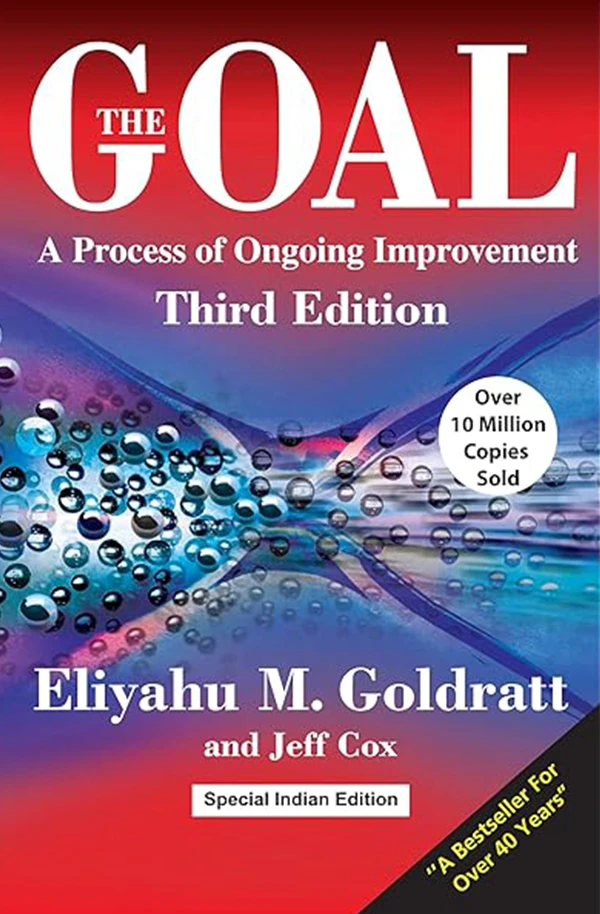
Detailed Review
I’ll start with a bias I had. A business book written as a novel did not sound like something I would take seriously. It felt like the format might dilute the thinking. However, as the story progresses, that concern fades. The narrative actually makes the ideas easier to absorb and, more importantly, easier to remember.
The situation is simple. A plant manager is given a fixed timeline to turn around performance or face shutdown. But this is not really about one factory. It is a representation of how most organisations operate. Busy, resource-heavy, and still underperforming.
The central idea is the Theory of Constraints. Every system has one constraint, and that constraint defines the output of the entire system. It sounds obvious when stated. However, in practice, most organisations behave very differently. They optimise for activity. They optimise for utilisation. And they optimise for local efficiency.
That is where the real problem sits.
The book makes a clear distinction between what looks productive and what actually creates value. High machine utilisation, fully engaged teams, and constant activity often give the impression of performance. However, if the constraint is not being managed, none of this translates into meaningful output. Throughput is the only metric that matters. Movement through the system, not motion within it.
From a leadership standpoint, this is where the book becomes relevant. It forces a shift in thinking. Instead of managing cost centres in isolation, the focus moves to managing flow across the system. And once you start looking at operations through this lens, many existing metrics begin to lose their meaning.
The framework itself is practical. Throughput, inventory, and operating expense are positioned as the three core measures. And the message is clear. Most organisations try to protect operating expense and end up compromising throughput. In doing so, they optimise the wrong side of the equation.
Having said this, the book is not without its limitations. The writing is straightforward and serves the idea. That works. However, the personal storyline around the protagonist feels extended in parts. It adds context, however it does not strengthen the central argument. For a leadership audience, it can feel like unnecessary noise.
However, the strength of the book lies in what it changes. It does not just introduce a concept. It changes how you diagnose problems. It challenges the assumption that being busy is the same as making progress. And once that shift happens, it is difficult to go back to traditional ways of measuring performance.
This is not a book you read for the narrative. It is a book you use as a thinking tool.
Rating: 9 out of 10
If you step back and assess your current operations, can you clearly identify the one constraint that is limiting your output, and are your decisions aligned to it, or are you still driving activity across the system without moving the outcome?