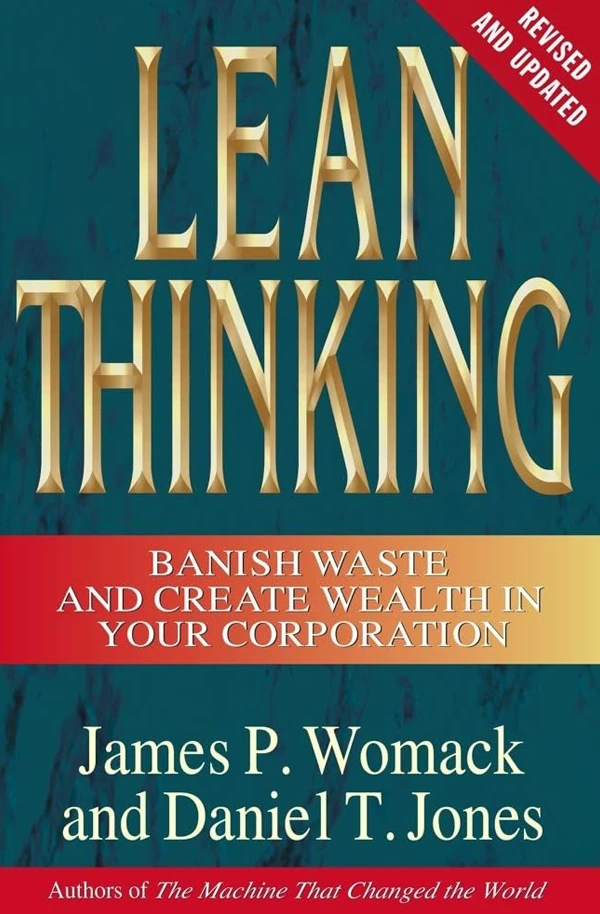
Detailed Review
Lean Thinking asks organisations to rethink how they see value, operations, and waste.
The main message: Anything that doesn't add customer value is waste.
The book focuses on five main principles:
- Define value from the customer’s perspective.
- Map the value stream.
- Create flow
- Establish pull
- Pursue perfection
The authors share real examples to show how cutting waste and improving flow can boost performance.
Strengths
1. Simple idea, powerful impact
The framework is simple to grasp but hard to put into practice. That challenge is what makes it last.
2. Grounded in real practice
This book is not full of theory. It is based on real changes, many of which are inspired by Toyota, making it practical and trustworthy.
3. More than a manufacturing concept
Lean thinking started in manufacturing, but now goes much further.
It works just as well in logistics, services, healthcare, and even government.
Ultimately, Lean is about gaining more value using fewer resources.
Limitations
1. Strong manufacturing bias
Most of the examples are from factories.
Readers in services or digital fields might need to adapt the ideas to fit their work. For logistics professionals, this means looking at your own processes, like transport routes, warehouse workflows, and inventory handling, to find steps that do not add value for the customer. Try mapping these processes, as the book suggests, for manufacturing, focusing on flow and identifying logistics-specific bottlenecks. Simple changes like these can make the manufacturing examples useful in your daily work.
2. Repetitive in parts
Some parts are dense and repeat ideas, which can slow down your reading.
3. Hard to implement in reality
Lean is simple to understand but tough to implement.
Implementing it means changing the culture, and that is where most organisations have trouble.It Matters for Logistics
Despite these challenges, Lean Thinking remains especially useful for logistics professionals.
- It helps you focus on creating real value, not just staying busy.
- Helps identify inefficiencies across transport and warehousing. For example, Lean Thinking can help reduce transport delays by streamlining loading and unloading processes, minimising unnecessary material handling, and optimising delivery schedules. In the warehouse, applying Lean principles can improve layout by placing high-turn items closer to dispatch, introducing clear pathways to reduce travel time, and designing standardised workstations to minimise motion and waiting. These specific actions lead directly to faster, more reliable logistics operations.
- Encourages flow-based network design instead of batch movement. By prioritising flow, logistics operations can achieve faster deliveries, smoother handoffs between stages, and reduced inventory levels. Flow-based design helps ensure that materials and information flow continuously rather than sitting idle in large batches, thereby reducing lead times and improving responsiveness to customer needs. This directly translates to more efficient, reliable logistics performance.
- It aligns well with today’s supply chain needs, such as agility and cost control.
In today’s complex and unpredictable supply chains, lean thinking is not optional. It is essential.
Key Takeaway
Lean is not a tool.
Lean is a mindset.
Most organisations do not fail because they lack tools, but because they do not rethink value, flow, and waste across the whole system. To start changing your mindset, try mapping out one logistics process from start to finish, like order fulfilment or inbound shipments. Ask yourself which steps truly add value for the customer and which are just extra work. Then, take your team on a 'waste walk' through the warehouse or transport area to spot waiting times, extra movement, or unneeded inventory. These first steps help everyone find quick wins and build momentum for bigger changes.
Verdict
To change your operations, read Lean Thinking and use its ideas now.
It might not be as entertaining as The Goal, but it gives you a deeper, more structured way to think.
If The Goal changes how you look at problems, Lean Thinking teaches you how to solve them step by step.
Rating: 4.5 / 5
Recommended For
Take action: Leaders, logistics professionals, operations managers, and anyone seeking significant efficiency gains should apply Lean Thinking in their work.