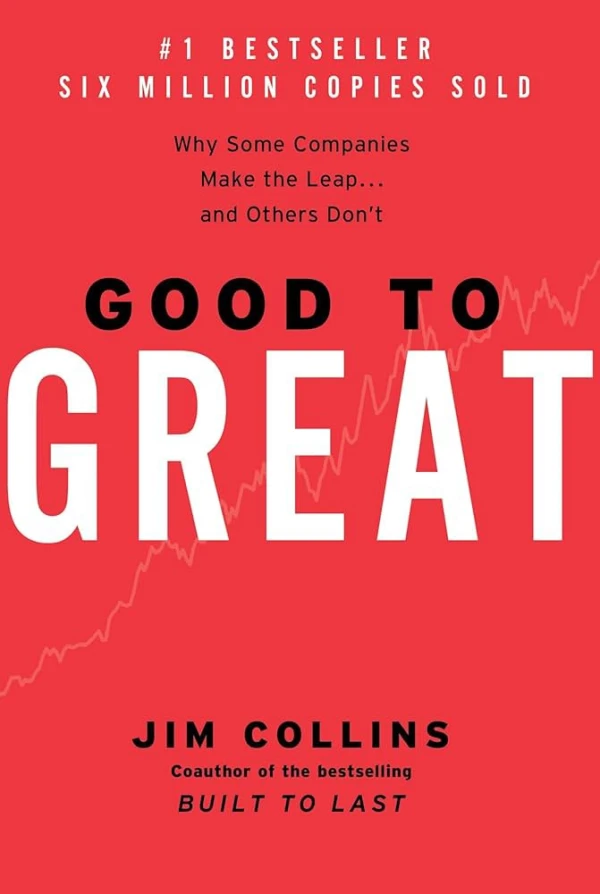
Detailed Review
Greatness Is Never an Event. It Is an Organisational Discipline.
Business literature is filled with books claiming to offer the formula for success, but few remain influential to boardrooms decades later. Good to Great by Jim Collins remains one of those few.
Instead of asking why successful companies succeed, Collins poses a more important question: What enables an ordinary company to become extraordinary and sustain that performance? That focus gives the book its lasting relevance.
Collins’ extensive research shows that sustained excellence rarely results from charismatic leadership, aggressive expansion, or breakthrough strategy alone. Instead, greatness comes from disciplined leadership, people, thinking, and execution.
For today’s business leaders facing technological disruption, geopolitical uncertainty, talent shortages, and compressed margins, these lessons remain highly relevant.
Leadership Before Strategy
Perhaps the book’s most significant contribution is its concept of the Level 5 Leader.
Modern business often celebrates visibility, rewarding personalities and amplifying individual brands. Collins challenges this by showing that enduring organisations are built by leaders who combine personal humility with strong professional resolve. They focus on institutional success instead of personal legacy, credit the team, and accept responsibility for failures.
As leadership is often mistaken for visibility today, this distinction warrants renewed attention.
The most sustainable organisations are rarely built around extraordinary individuals. Instead, they are formed by extraordinary leadership behaviours.
People Remain the Ultimate Competitive Advantage
One of the most powerful principles in the book is captured in a simple phrase:
“First Who… Then What?”
Many organisations invest heavily in improving strategy before making sure they have the right people to execute it. In reality, the right people shape the right strategy.
This principle is even more relevant today as businesses adopt AI, automation, analytics, and digital platforms. Although technology can redefine processes, organisational capability still depends on people with competence, integrity, adaptability, and a sense of ownership.
The quality of execution is ultimately determined by the quality of the people entrusted with it.
The Hedgehog Concept: Strategic Clarity Matters
Another framework that continues to influence executive thinking is the Hedgehog Concept.
Collins suggests that every organisation should identify the intersection of three critical questions:
- What can we genuinely become the best at?
- What are we strongly passionate about?
- What drives our economic engine?
The framework’s simplicity frequently masks its difficulty.
Many organisations try to compete across multiple markets, products, and customer segments without attaining genuine strategic clarity.
Great companies rarely pursue everything.
They deliberately choose where not to compete.
In today’s complex business environment, disciplined focus offers a greater competitive advantage than diversified ambition. The Flywheel Effect illustrates this clearly.
Transformation rarely happens through dramatic announcements or overnight change.
Instead, persistent success comes from consistently making many small decisions that reinforce one another until momentum becomes self-sustaining.
This perspective is particularly relevant for organisations pursuing digital transformation.
Technology investments alone do not create competitive advantage.
Competitive advantage arises when disciplined execution aligns people, processes, technology, governance, and customer value over time. The Flywheel Effect reminds executives that endurance and consistency often outperform haste without direction.
Where the Book Promotes Healthy Scepticism
No serious management book should be accepted without a critical review.
Several companies celebrated in Good to Great, including Circuit City and Fannie Mae, later experienced significant declines.
This has led to valid criticism about survivorship bias and the limits of retrospective analysis.
Business environments evolve.
Industries change.
Competitive advantages erode.
No system provides permanent protection from disruption.
However, this does not diminish the main contribution of Collins’ work. His principles stay remarkably resilient.
Leadership discipline, organisational culture, strategic clarity, operational excellence, and long-term thinking continue to distinguish enduring organisations from average ones.
The lesson is not that greatness is permanent.
The lesson is that greatness requires continuous renewal.
Executive Reflection
What makes Good to Great valuable is not that it offers a formula for success.
It offers a framework for disciplined decision-making.
Whether one leads a logistics company, a manufacturing enterprise, a technology platform, or a public institution, the underlying message is consistent: Leadership matters more than charisma.
- Culture outlasts strategy.
- People outperform processes when empowered correctly.
- Discipline compounds into competitive advantage.
- Sustainable greatness is built deliberately, not by accident.
In today’s environment of AI-led transformation, resilient supply chains, and rapidly changing customer expectations, these principles feel more relevant than ever.
Technology may restructure industries.
Leadership still determines outcomes.
Final Verdict
Good to Great is not a blueprint that guarantees organisational success. Instead, it operates as a lasting leadership reference, encouraging executives to look beyond quarterly results and focus on building institutions capable of sustained excellence.
The examples may belong to another era, but the questions Collins asks remain timeless.
Every leader must eventually answer them.
Rating: 4.5/5
A management classic that still shapes executive thinking—not because it predicts the future, but because it teaches the disciplines needed to build it. In that sense, Good to Great is a lasting indication that disciplined leadership still matters.